DLR logo

Success Story

German Aerospace Center (DLR) 

The German Aerospace Center (DLR) is the aerospace research center of the Federal Republic of Germany. Its research and development work in aeronautics, space, energy, transport and security is integrated into national and international co-operations. Over 11.000 employees, scientists and engineers work in 54 institutes and facilities on 30 sites. 

The DLR Institute of Communications and Navigation is dedicated to mission-oriented research in selected areas of communications and navigation. Its work ranges from the theoretical foundations to the demonstration of new procedures and systems in a real environment and is embedded in DLR’s Space, Aeronautics, Transport, Security and Digitalization programs. The Institute currently employs around 255 staff, including about 190 scientists at the locations Oberpfaffenhofen and Neustrelitz and Aachen-Merzbrück. 

The department Optical Satellite Links deals with the application of optical technologies in satellite communication and related topics. The department is internationally networked with all this work, is involved in numerous international projects and, in particular, maintains close relationships with selected industrial companies. The transfer of the technologies and know-how developed to industry is one of DLR’s key objectives and is consistently pursued. 

DLR’s Challenge

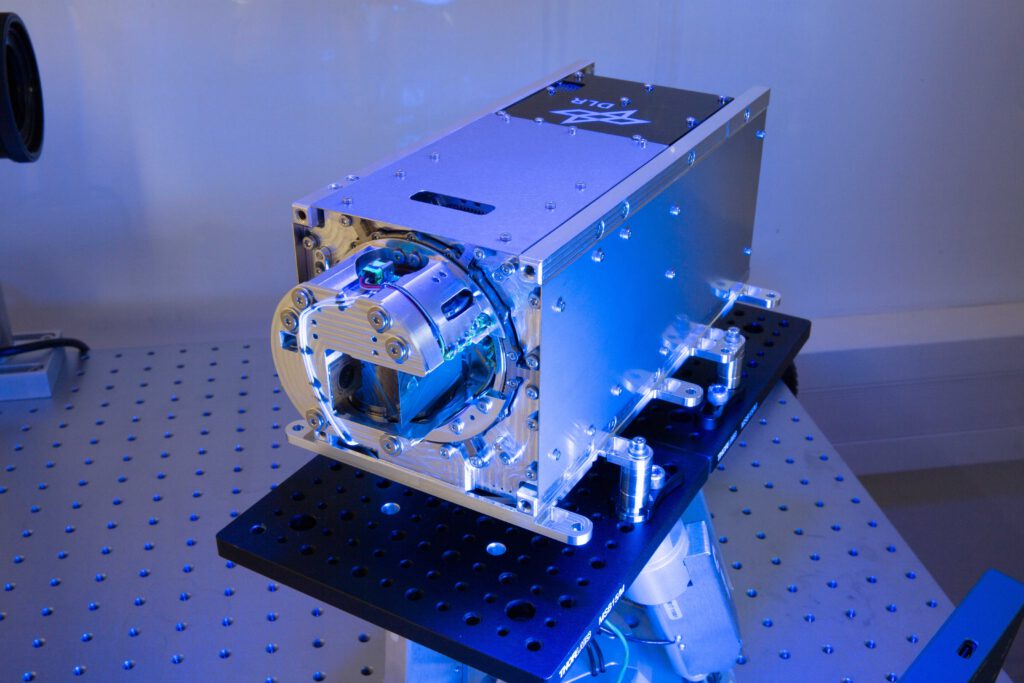
DLR has been working on Cube1G, a laser communication terminal developed for small satellites and CubeSats to provide bidirectional optical communication with a data rate of up to 1 Gbit/s. 

To enable parallel operation and communication with the satellite, Cube1G is equipped with a Coarse Pointing Assembly (CPA), that can steer the laser beams independently from the platform’s attitude.  

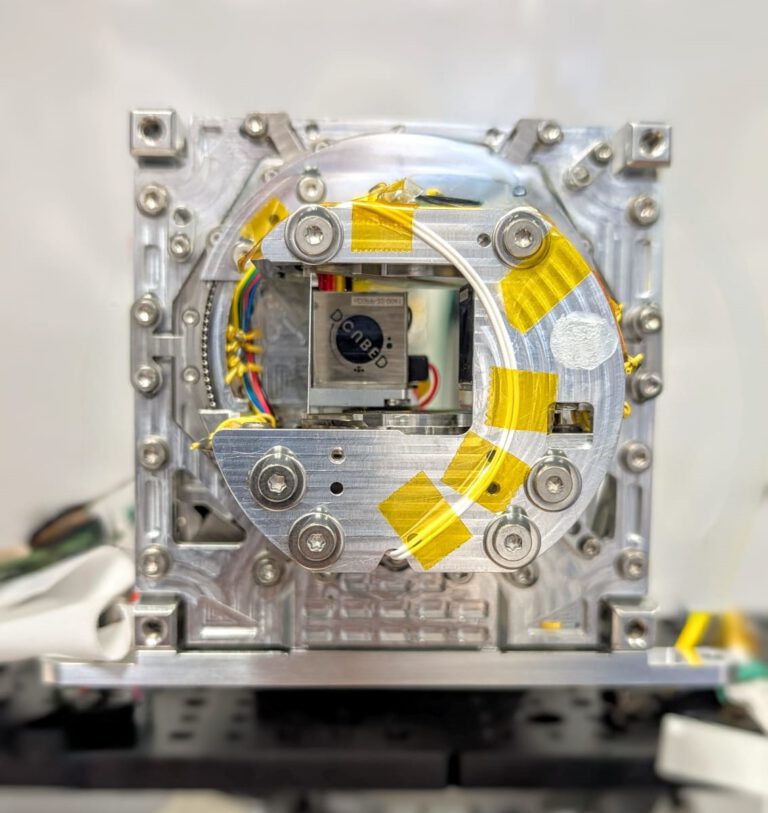
The CPA moves freely in azimuth and elevation, but it must be kept stationary during the rocket launch. Therefore, two nD3PP were selected to be used as a launch lock that keeps the CPA fixed during the launch and will be released in the commissioning phase in space.  

Dcubed Solution

The integrated Cube1G payload had to be tested and qualified for the final in-orbit demonstrator mission in the SeRANIS (Seamless Radio Access Networks for Internet of Space) project. Especially the high vibration loads were challenging for the design, and DLR experienced a nD3PP Pin Puller getting stuck after vibration testing.

To help, a Dcubed Customer Solutions Engineer went on-site to DLR to identify the cause as a galling material combination between the pin and the corresponding socket. The socket could be redesigned using a material combination suggested by Dcubed. With the updated parts in place, the payload was successfully shaker-qualified two weeks later.  

Dcubed Impact

Dcubed was very supportive and developed solutions together with DLR engineers. The flexible and responsive support was one key to our successful development, alongside the key features of the nD3PP, including its form factor and compact design, as well as short lead time.